
Insertion Sort
This content is for DSA. Switch to the latest version for up-to-date documentation.
Insertion sort is a simple sorting algorithm that builds the final sorted array one element at a time. It works by taking elements from the unsorted portion and inserting them into their correct position in the sorted portion, similar to how you might sort playing cards in your hand.
Properties
Section titled “Properties”- Comparison-based: Works by comparing elements to find correct position
- In-place sorting: Sorts the array without using extra space
- Stable algorithm: Maintains relative order of equal elements
- Adaptive: Performs better on partially sorted arrays
How it Works
Section titled “How it Works”- Start with second element: Assume first element is already “sorted”
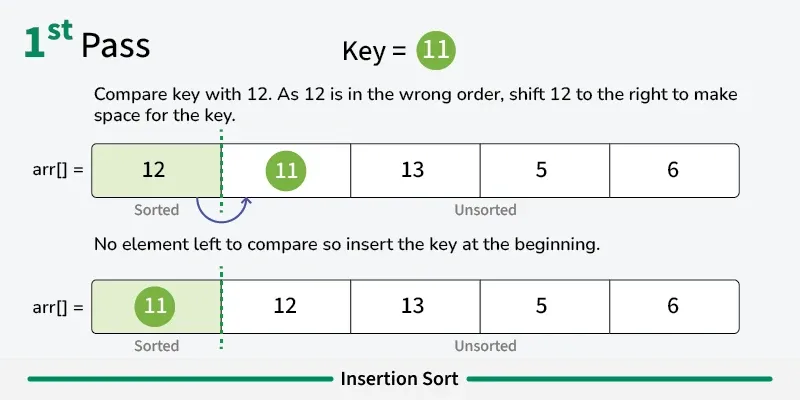
- Pick current element: Take the next element from unsorted portion
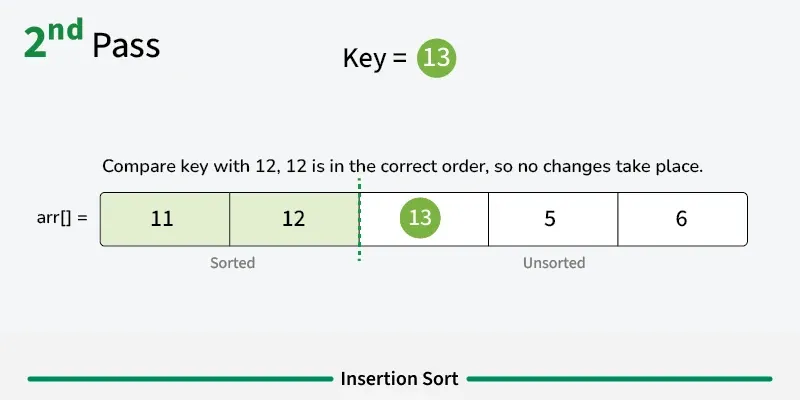
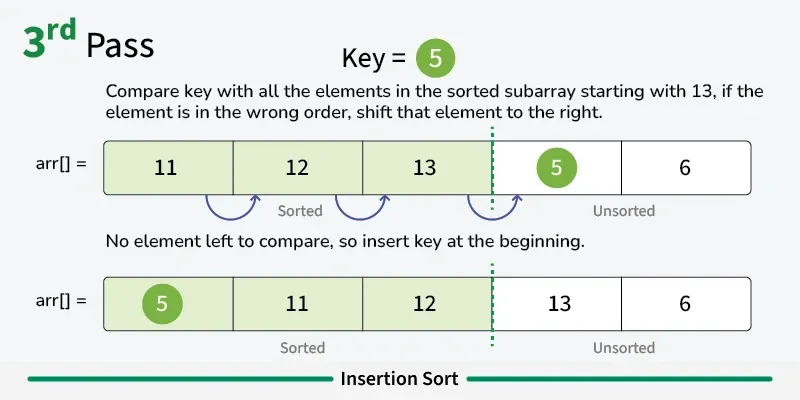
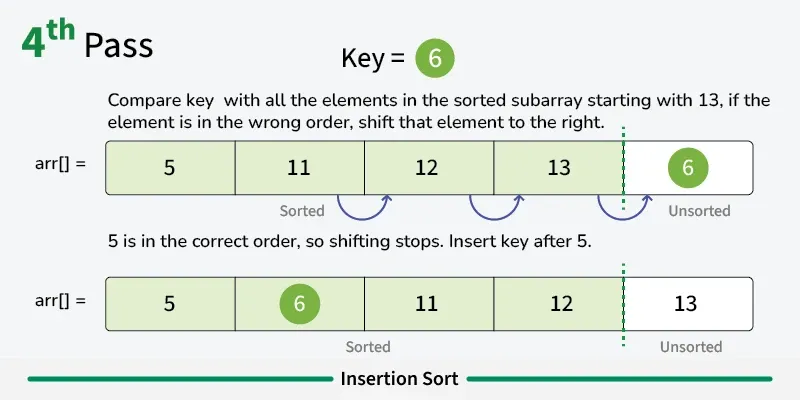
- Compare with sorted elements: Compare with elements in sorted portion (from right to left)
- Shift elements: Move larger elements one position to the right
- Insert in correct position: Place current element in its correct position
- Expand sorted portion: The sorted portion now includes the inserted element
- Repeat: Continue with next element until all elements are processed
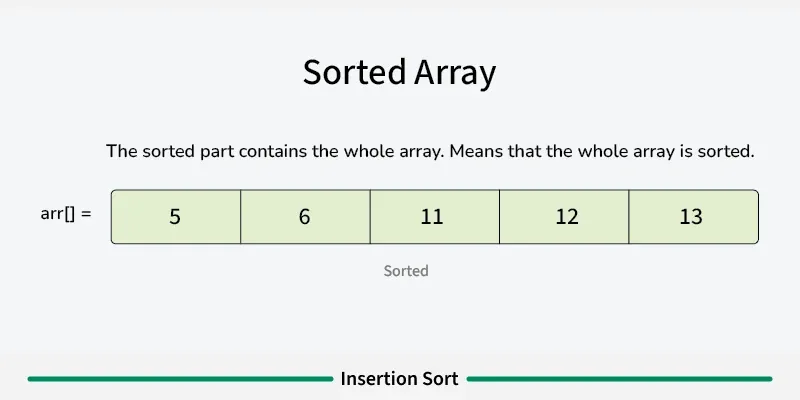
- Done: Array is fully sorted
Use Cases
Section titled “Use Cases”- Small datasets: Efficient for small arrays (typically < 50 elements)
- Nearly sorted data: Performs excellently on already sorted or nearly sorted data
- Online algorithm: Can sort data as it’s received
- Hybrid sorting algorithms: Used as a subroutine in advanced algorithms like Quicksort
Time Complexity
Section titled “Time Complexity”- Best case: O(n) - When array is already sorted
- Average case: O(n²) - Random order of elements
- Worst case: O(n²) - When array is reverse sorted
Space Complexity
Section titled “Space Complexity”- O(1): Constant space, only uses a few variables
Advantages
Section titled “Advantages”- Simple implementation: Easy to understand and code
- Efficient for small datasets: Better than other O(n²) algorithms for small arrays
- Adaptive: Performance improves with partially sorted data
- Stable: Maintains relative order of equal elements
- In-place: Requires only constant extra memory
- Online: Can process elements as they arrive
Disadvantages
Section titled “Disadvantages”- Poor performance on large datasets: O(n²) time complexity is inefficient for large arrays
- More comparisons than selection sort: Generally performs more comparisons
- Not suitable for large-scale applications: Better algorithms exist for large datasets
Example
Section titled “Example”public class InsertionSort { // Basic insertion sort implementation public static void insertionSort(int[] array) {
// 📌 Part 1: Start from second element (index 1) since first element is considered sorted for (int i = 1; i < array.length; i++) {
// 📌 Part 2: Keep track of current element and last sorted position int currentElement = array[i]; // Element to be inserted int j = i - 1; // Index of last element in sorted portion
// 📌 Part 3: Shift elements that are greater than currentElement to one position ahead while (j >= 0 && array[j] > currentElement) { array[j + 1] = array[j]; // Shift element to right j--; }
// 📌 Part 4: Insert currentElement at its correct position array[j + 1] = currentElement;
}
}
public static void main(String[] args) { int[] numbers = {64, 34, 25, 12, 22, 11, 90};
System.out.print("Original: "); for (int num : numbers) { System.out.print(num + " "); }
insertionSort(numbers); System.out.println();
System.out.print("Sorted: "); for (int num : numbers) { System.out.print(num + " "); } }}Visualization
Section titled “Visualization”